Should You Make Repairs or Sell As-Is in the Flathead Valley?
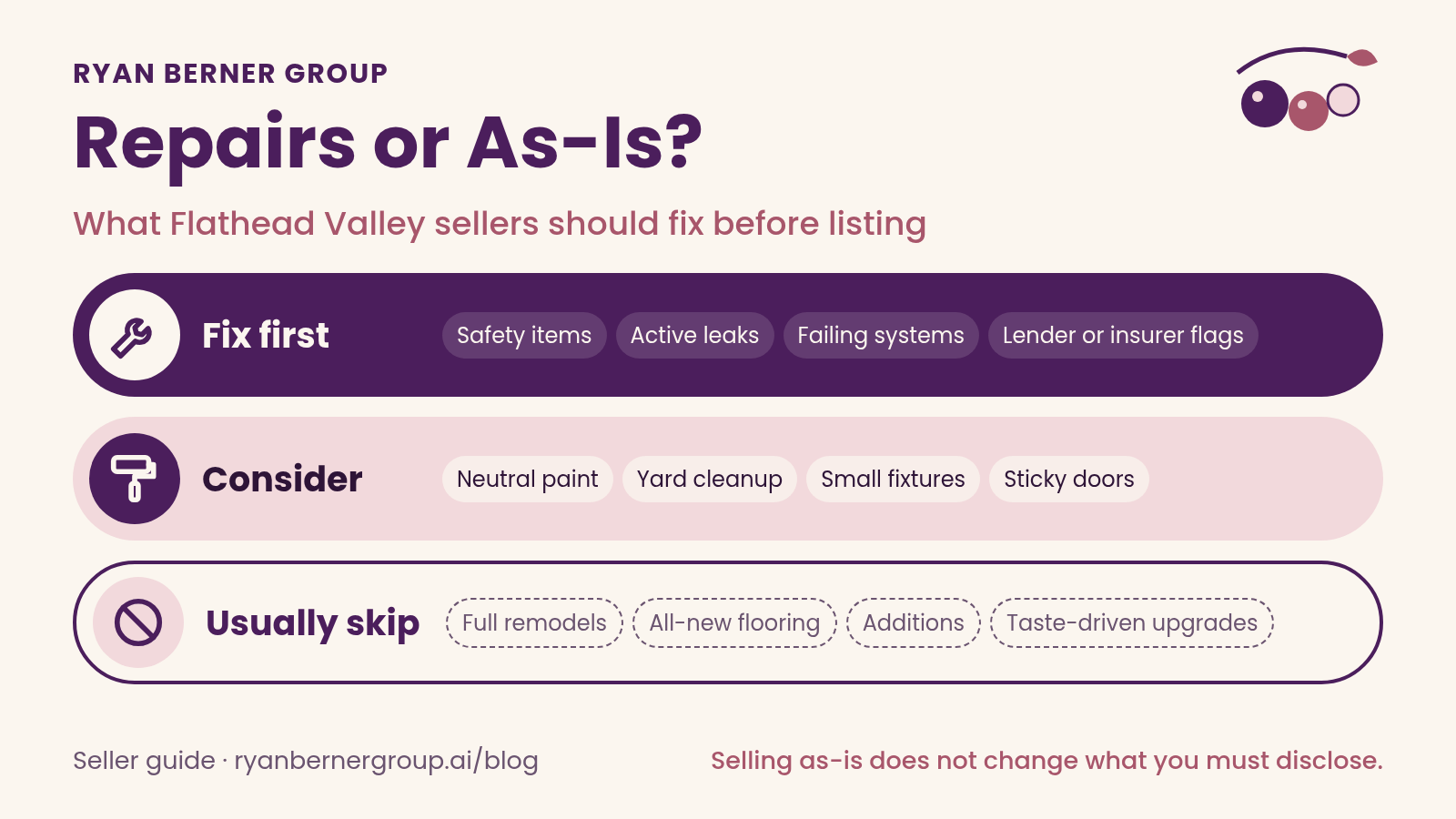
Short answer: Most Flathead Valley sellers land in the middle. Fix what affects safety, function or a buyer’s ability to finance the home, consider small cosmetic refreshes, and usually skip big remodels. Selling as-is is a separate thing from Montana’s seller disclosure law, which requires a written disclosure statement in transfers of residential real property (MCA 70-20-502, accessed Oct 24, 2026). Whether that law applies to your sale is a question for your attorney.
By Ryan Berner, Kalispell REALTOR®
What does “selling as-is” actually mean?
Plain definition: selling as-is means you’re offering the home in its current condition and telling buyers up front that you don’t plan to make repairs. Buyers can usually still inspect, and they can still walk away or renegotiate based on what they find, depending on the terms of the contract.
What it isn’t: an as-is label is not Montana’s seller disclosure statement. Montana law requires the seller in a transfer of residential real property to give the buyer a written disclosure statement of adverse material facts the seller actually knows about, including matters such as the roof, well, septic system, foundation, plumbing or water intrusion (MCA 70-20-502, accessed Oct 24, 2026). The law defines residential real property to include property with one to four dwelling units (MCA 70-20-501, accessed Oct 24, 2026) and lists transfers that are exempt (MCA 70-20-503, accessed Oct 24, 2026). Whether the requirement or an exemption applies to your sale, and what you need to disclose, is a question for your attorney.
Which repairs are usually worth making before you list?
The repairs that tend to matter most are the ones a buyer’s inspector, lender or insurer will flag anyway:
- Safety items: missing handrails, exposed wiring, broken steps, smoke and carbon monoxide detectors.
- Water problems: active roof leaks, plumbing leaks, poor drainage near the foundation.
- Systems that don’t work: a furnace, water heater or well pump that’s failing.
- Anything that could stall financing or insurance: some loan programs and insurers look closely at roof condition, heating and obvious safety issues.
Fixing these before you list takes away easy reasons for a buyer to ask for a lower price late in the deal.
Which repairs can you usually skip?
Large projects rarely pay for themselves right before a sale. A full kitchen remodel, new flooring throughout or an addition takes time, adds stress and still might not match a buyer’s taste.
Small cosmetic work is the gray area. Fresh neutral paint, replacing a cracked light fixture, cleaning up the yard and fixing sticky doors are inexpensive and help a home photograph and show better. Whether they’re worth it depends on the home and the price range.
When does selling as-is make the most sense?
As-is often fits when:
- The home needs more work than it’s sensible to take on, such as an older cabin or a house that hasn’t been updated in decades.
- You’re settling an estate or selling a home you’ve inherited and can’t easily manage repairs from a distance.
- Timing matters more than top dollar, for example a job move or a divorce.
- The value is mostly in the land, such as acreage near Kalispell or Columbia Falls where buyers may plan to rebuild.
In these cases, pricing the home realistically for its condition matters more than any single repair.
What should Montana sellers check that other sellers might not?
Rural Flathead properties come with items buyers in town don’t think about:
- Wells: buyers and lenders often want a water test and a look at the well’s output.
- Septic systems: a septic inspection is common, and problems can be costly to fix.
- Winterization: a vacant home over a Flathead winter can have frozen-pipe damage if the heat fails.
- Roof and snow load: buyers notice sagging, ice damming and missing flashing.
Knowing the condition of these before you list helps you decide whether to fix, disclose and price for it, or offer a credit.
Is a repair credit better than doing the work?
Sometimes. A credit lets the buyer choose their own contractor and avoids delays before closing. Doing the work yourself can make the home easier to finance and can reassure buyers who don’t want projects. Whichever you choose, keep receipts and any warranties so you can show what was done.
Questions to ask before you decide
- Would a buyer’s inspector or lender likely flag this item?
- Will fixing it change how the home shows in listing photos?
- How long will the repair take, and will it push back my listing date?
- What do I need to disclose? (Ask your attorney.)
- Would a credit or a price adjustment be simpler than the repair?
FAQ
Can I sell my house as-is in Montana?
Ask your attorney. Offering a home in its current condition is common, and buyers can still inspect. Montana’s seller disclosure law is a separate requirement (MCA 70-20-502, accessed Oct 24, 2026); whether it applies to your sale is a question for your attorney.
Will selling as-is lower my price?
It can, because buyers factor in the work they’ll need to do. A realistic price for the home’s condition is what makes an as-is sale work.
Should I get a pre-listing inspection before deciding?
It can help. An inspection before you list shows you what buyers are likely to find, so you can decide what to fix, what to disclose and how to price.
Do I have to fix what the buyer’s inspector finds?
Repairs after inspection are usually negotiated: sellers often agree to fix items, offer a credit, adjust the price or decline. What your contract requires is a question for your attorney.
What’s my home worth?
If you’re weighing repairs against selling as-is, start with what your home is worth in its current condition. Request your value range at What’s my home worth?, or call or text (406) 709-5404.