Selling Land With Water Rights in Montana: What Flathead Sellers Should Know
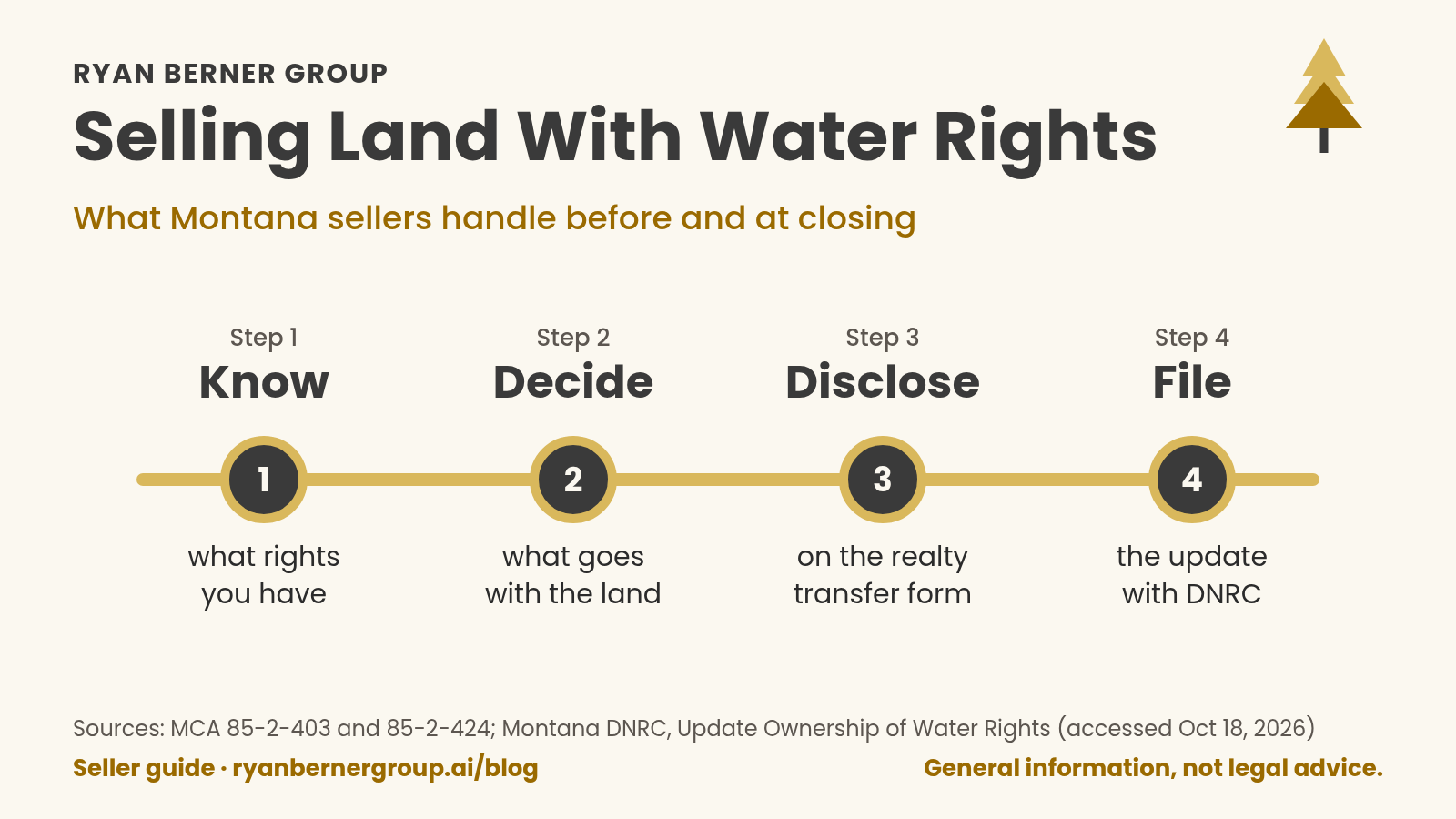
Short answer: Montana law says the right to use water passes with a conveyance of the land unless specifically exempted (MCA 85-2-403, accessed Oct 24, 2026). The realty transfer certificate carries a water rights disclosure, the DNRC ownership update fee is paid at closing, and dividing, exempting or severing a water right involves a form filed with DNRC (MCA 85-2-424, accessed Oct 24, 2026). How these rules apply to your property is a question for your attorney.
By Ryan Berner, Kalispell REALTOR®
What is a water right?
Plain definition: a water right is the legal right to use a certain amount of water from a certain source for a certain purpose, such as irrigation, stock water or a household. In Montana, water rights are recorded with the Department of Natural Resources and Conservation (DNRC), and they’re separate from simply having a creek, pond or well on the property.
That difference matters to buyers looking at acreage around Kalispell, Columbia Falls, Bigfork or the Lower Valley. A pasture with an irrigation right and a pasture without one can be very different properties to the right buyer.
Do water rights transfer automatically when I sell?
Montana law says the right to use water passes with a conveyance of the land unless it’s specifically exempted (MCA 85-2-403, accessed Oct 24, 2026). Whether anything in your deeds or your sale changes that is a question for your attorney.
DNRC says ownership of the water right must be expressly addressed in a deed or other recorded document when a right is divided, exempted or severed (DNRC, Update Ownership of Water Rights, accessed Oct 24, 2026). Whether to keep, split or sever a right is a question for your attorney.
What is the water rights disclosure?
Montana requires a water rights disclosure on the realty transfer certificate. The seller acknowledges, at or before closing, whether any water rights are associated with the property and whether they’ll transfer with it (MCA 85-2-424, accessed Oct 24, 2026). Transfers of property served by a public service water supply are excluded from this requirement.
The same statute says any written agreement to transfer land with water rights on record must include a water right ownership update disclosure. It warns that failing to pay the required DNRC fee at closing may result in a penalty for the buyer, and that mistakes when rights are exempted, severed or divided can lead to the deed being rejected for recording.
Which DNRC forms come into play?
DNRC lists these forms on its ownership update page (DNRC, accessed Oct 24, 2026):
- Form 608, Water Right Ownership Update: for a change in ownership of an entire water right.
- Form 641: for a water right that has been divided.
- Form 642: for a water right that has been split and severed.
- Form 643: for a water right that has been fully severed.
DNRC notes that Form 608 isn’t used by people on a municipal or irrigation district water system.
How long does DNRC take to update ownership?
DNRC must update its records within 30 days after it receives a complete ownership update form or qualifying information from the Department of Revenue (MCA 85-2-424, accessed Oct 24, 2026).
When a parcel is split and the water right is divided, each buyer receiving part of the right files their own update form with a map. If not everyone files, the statute says the parties are listed as co-owners on the right.
What should I gather before listing land with water rights?
Having these ready helps buyers understand what they’re getting and keeps the deal from stalling:
- The water right numbers tied to your property, and what each one is for.
- Recorded deeds that show whether earlier owners kept, split or severed any rights.
- Irrigation or ditch company paperwork, if your water comes through a shared system.
- Well logs and any water test results for household wells.
- A clear decision on whether every right goes with the land or some are being kept or divided.
If anything looks unclear, such as a right still listed under a previous owner’s name, DNRC and a Montana water rights attorney are the right people to ask. This post is general information, not legal advice.
Why does this matter more on larger properties?
On ranches, acreage and waterfront homes, buyers often weigh water as part of the value. A buyer comparing two properties will ask what the rights allow, how reliable the source is and whether the paperwork is clean. Clear answers up front make your listing easier to compare and give buyers fewer reasons to hesitate.
FAQ
Do water rights go with the land when I sell in Montana?
Montana law says the right to use water passes with a conveyance of the land unless specifically exempted (MCA 85-2-403). How that applies to your sale is a question for your attorney.
Can I keep my water rights and sell the land?
Ask your attorney. Montana law allows a water right to be exempted from a conveyance of the land (MCA 85-2-403), and exempting or severing a right involves a form filed with DNRC (MCA 85-2-424). Whether and how to do that is a question for your attorney.
Who files the water right ownership update?
The statute makes the buyer responsible for compliance after receiving notice from DNRC, and the fee is paid at closing (MCA 85-2-424). Who handles it in your sale is a question for your attorney and your title or escrow company.
Does a house on city water need a water rights disclosure?
Montana’s water rights disclosure on the realty transfer certificate excludes transfers of property served by a public service water supply (MCA 85-2-424). Whether your property falls under that exclusion is a question for your attorney.
What’s my home worth?
If you’re thinking about selling acreage or a property with water rights, start with a clear picture of its value. Request your value range at What’s my home worth?, or call or text (406) 709-5404.